Setting Mechanism of Elastic Fabrics
——Zhu Lin, textile industry veteran
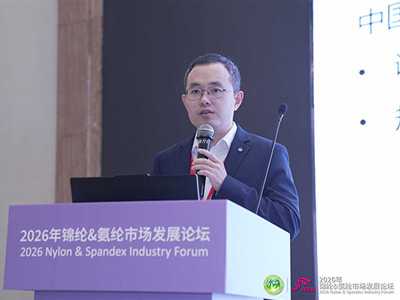
Zhu Lin, a textile industry veteran, presented Setting Mechanism of Elastic Fabrics, which examined heat setting at the molecular level through the lens of polymer physics and crystallography. He discussed how the industry can reconcile high setting temperatures with the push for energy savings and greater fiber diversity.
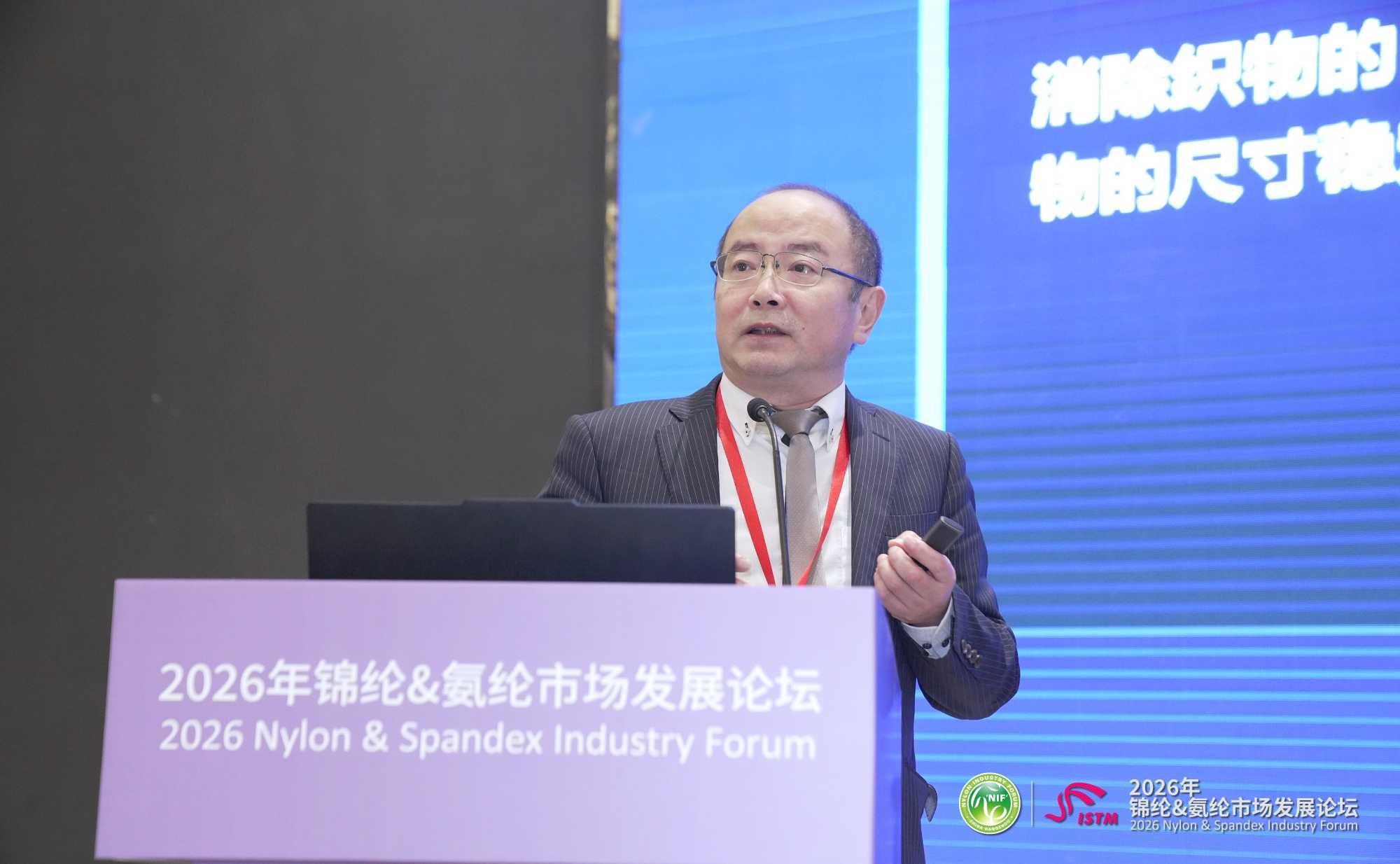
Zhu noted that fibers build up considerable internal stress during spinning, fabric formation, dyeing and finishing. Heat setting relieves this stress and improves dimensional stability by using moisture, heat and tension to reorganize the crystalline, amorphous and rigid amorphous regions of the fiber. Elastic fabrics are harder to set: they involve a large amount of delayed elastic deformation, and their soft segments only stabilize once they reach an all-trans conformation at high temperature. Setting must also take place between the glass transition and melting temperatures. Too low, and the molecular chains are frozen in place; too high, and the fiber turns viscous and loses strength. The core difficulty, Zhu stressed, lies in fabrics containing dry-spun spandex, where a single heat treatment must satisfy two entirely different setting requirements.
His solution works at the fiber level: lowering hard-segment crystallinity. By adjusting the proportion of 2,4'-MDI, the dry heat-setting temperature of spandex can be cut from the conventional 180-195°C to 130°C. This prevents dye migration caused by the sublimation of disperse dyes at high temperatures, and lets pre-setting and re-setting each fall within the optimal window of a different fiber component. The resulting loss in physical crosslinking can be offset by increasing hydrogen bonding. The approach offers a clear technical path toward a low-temperature, low-carbon and recyclable elastic fabric ecosystem.